Back-to-School Resources for Rett Syndrome
For many families, the start of a new school year is filled with excitement. Fresh school supplies, new teachers, and the promise of new friendships make it a season of anticipation.
For families of children with Rett syndrome, however, back-to-school often brings a very different set of emotions.
Instead of simply preparing backpacks and lunchboxes, parents are coordinating medical needs, updating communication systems, meeting with educators, revising educational plans, and hoping that a new team will truly understand their child.
There can also be a lot of turnover within our school teams. So while everyone else is celebrating a fresh start, Rett families are often carrying the weight of starting over.
We’re here to help.
What is Rett Syndrome?
One of the first questions new teachers, therapists, and support staff often ask is, "What is Rett syndrome?"
The answer isn't always simple. Every individual with Rett syndrome is unique, and new staff members have a lot to learn—not only about the diagnosis itself, but also about how to communicate with, support, and care for your student.
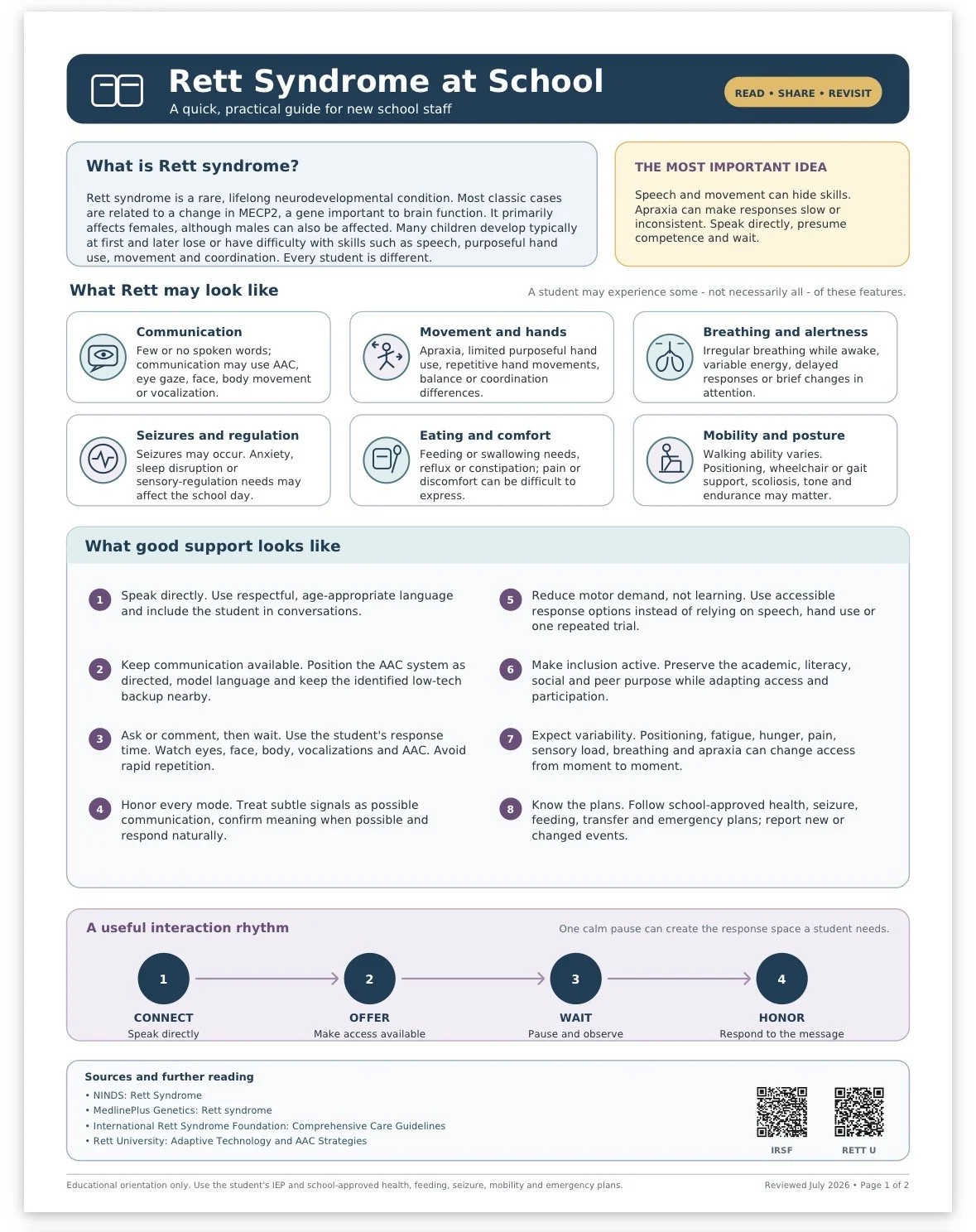
That's why we created our Rett Syndrome School Handout. This fillable, two-page resource is designed to give school staff a clear, easy-to-understand overview of Rett syndrome while also providing individualized information about your child.
The first page explains what Rett syndrome is and highlights common characteristics and symptoms. The second page includes customizable sections where parents or caregivers can share important details about their child, including mobility and positioning, breathing and alertness, eating and drinking needs, communication methods, and other individualized supports.
Providing this information before the school year helps establish a strong foundation for your child's educational team. It gives staff a better understanding of what to expect, while offering practical guidance that helps them provide safe, personalized, and compassionate care from day one.
Communication 101
Many students with Rett syndrome communicate using Augmentative and Alternative Communication (AAC), often through an eye gaze device. While this technology can open the door to meaningful communication, having an AAC device alone doesn't guarantee successful communication. It’s just as important to have a team of communication partners who know how to support the student throughout the school day.
Every member of your child's educational team should receive training on how to:
Use the eye gaze system and understand how it works.
Model language consistently throughout the day.
Allow adequate wait time for responses.
Recognize intentional communication, knowing that it may look different from day to day.
Naturally incorporate AAC into classroom routines and daily activities.
Without training and consistency from staff, opportunities for learning, participation, and connection may be very limited.
If you're looking for a great place to start, Episode 04: Communication & Education: A Conversation with Susan Norwell & Kourtney Barnum is an excellent resource to share with teachers, therapists, aides, and other school staff.
In this episode, two internationally recognized Rett syndrome educators discuss AAC fundamentals, presuming competence, classroom inclusion, and practical strategies for supporting students with complex communication needs.
For teams that want to dive deeper, Rett University offers a variety of professional development opportunities for both schools and families. Their library includes in-depth training courses as well as many free resources that can help educators build confidence in supporting students with Rett syndrome.
To help your team get started, we also recommend sharing these free printable resources:
One-Page Communication Sheet – A quick reference guide that introduces staff to your child's communication methods and strategies.
Yes/No Communication Cards – Simple visual supports that help establish reliable yes/no responses and encourage meaningful interaction.
Daily Home-to-School Communication
Strong communication doesn't end with your student's AAC device. It also extends to the partnership between home and school.
Because many individuals with Rett syndrome can't easily tell their families about everything that happened during the school day, consistent communication from staff is invaluable. Parents rely on these updates not only to monitor their child's health and well-being, but also to celebrate the meaningful moments that make up their school day.
Of course, medical information is important. Details about bathroom habits, eating and drinking, seizure activity, or changes in mood and alertness can help families identify patterns and ensure continuity of care.
But parents also want to hear about the everyday moments that make school special. Did their child laugh during music class? Who did they sit with at lunch? Did they enjoy art? Was there a favorite activity or a moment that made them smile?
Our fillable Daily Communication Log makes it easy for families and school staff to share these important updates in one convenient, digital document. Rather than relying on scattered notes or trying to remember details at pickup, the form creates a consistent way to keep everyone informed.
Staff can quickly document information such as:
Highlights and challenges from the day
Notable peer interactions and social experiences
Participation in therapies, specials, and classroom activities
Preferred daily communication methods
Health updates, including eating, drinking, toileting, and overall demeanor
A few minutes of communication each day can make a tremendous difference. It helps families stay connected to their child's school experience and strengthens collaboration with the educational team.
An “About Me” Page
An About Me page is a quick way to get a teacher, aide, or new staff member acquainted with your student. Add in your own student’s details, or tailor this template to pass out to classmates as a take-home to educate other class families.
This tool can also serve as a way to share basic information about equipment needs, calm down strategies, or a method for staff to discover similarities between peers.
AAC Reminders
Your student’s device is his or her voice, so it should travel with your student wherever they go during the school day. A visible sticker can serve as a gentle nudge to let staff know about your expectations. Post it on the back of their device or in its carrying case. Here is the purchase link for the sticker above.
Additional Resources for the Team
Preparing a new educational team doesn't have to fall entirely on your shoulders. Fortunately, several organizations have created excellent resources to help educators, therapists, and support staff better understand Rett syndrome and confidently support students in the classroom.
Here are a few of our favorite resources to share before or throughout the school year:
An extension to the expert advice on Rett University’s website, their recorded webchats can answer questions about more specific topics like soft questioning, writing, CVI supports, and how to measure progress.
Specific therapy guidelines for Rett syndrome developed for professionals (PT, OT, aquatic therapy, music therapy, etc.) from Rett Syndrome Research Trust. Share with school therapists who may be new to Rett syndrome or may just need a refresher.
A fillable IEP checklist to prepare for your upcoming IEP meeting.
A video library housing recorded webinars on various topics ranging from championing your child’s potential in school, nutrition, epilepsy, and physical therapy goals (hosted by International Rett Syndrome Foundation).
Written by parents, this blog post from Rocky Mountain Rett Association shares ideas from lived experiences, like using a personalized name stamp for your child to write their name on work.
It’s a Remix.
Back-to-school season will probably always bring a mix of excitement and anxiety for Rett families.
There will be meetings to attend, emails to send, equipment to organize, and plenty of unknowns ahead. We know this probably isn’t the back-to-school plan you had once imagined.
But each new school year also brings the possibility of new relationships, greater understanding, and meaningful growth for your child.
We hope these tools will help kick the school year off to a great start!
Do you have an idea to share? Email us!
admin@therareremix.com
RELATED ARTICLES